Three people, one city
About Charlotte Commercial Door Service
One city, a known set of buildings, and the part already on the van.
A small outfit that decided coverage was the problem
Most commercial door contractors expand outward. More towns, more counties, more vans, and eventually a dispatch layer between the person who takes the call and the person who turns up. It is a reasonable way to grow a business and it makes the actual work worse, because every mile of added coverage dilutes the one thing that decides whether a door gets fixed on the first visit: knowing, before you leave, what is probably on that opening.
Charlotte Commercial Door Service went the other way on purpose. Charlotte, three people, and a parts inventory chosen for the building stock inside one city.
How it started
Merritt Kanipe spent years on multi-site facilities work, running door and hardware calls dispatched from a call centre in another state. The pattern that eventually pushed him out was not the driving. It was the second visit. A work order would arrive saying a door would not latch. It would not say what kind of door, what was hanging on it, whether the frame was hollow metal or aluminum, or whether the previous technician had already replaced the strike. So the first visit became a survey with a toolbox, and the repair happened days later once a part had shipped.
He worked out at some point that the information needed to bring the right part was almost never technical. It was situational. Where is the opening. What goes through it. What changed. A technician who knows the buildings in one city can answer all three before getting in the van, and a technician covering half a state cannot answer any of them.
The outfit was built around that. Renata Ocampo takes the calls and runs the parts, which are the same job here rather than two departments. Deshawn Pruitt came off dock and industrial work and handles the openings that get hit by things. Merritt takes the glass line, the entrances and anything on a labelled assembly. Nobody is a dispatcher and there is no one here who has not been on a job site this month.
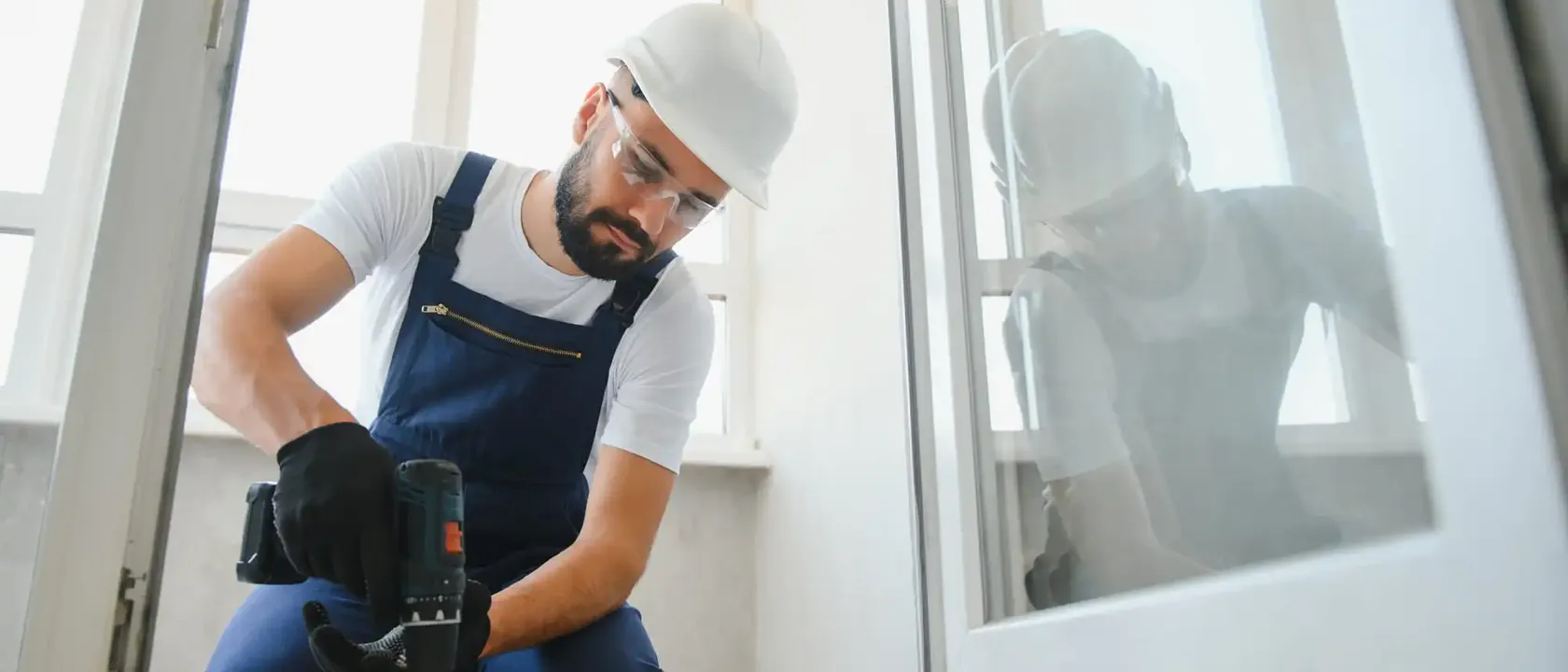
The three of us
Owner, and the technician on entrances, glass and labelled openings
Merritt Kanipe
Years of multi-site commercial door work across the Carolinas before starting this. Handles aluminum entrance systems, all-glass door lines with patch fittings and floor closers, and anything hanging on a fire-rated assembly where the wrong part voids a listing. Takes most of the phone calls that come in outside business hours because the phone rings to him.
Service coordinator and parts
Renata Ocampo
Answers the phone, works out what the opening probably is, and pulls the parts before the van leaves. Came from a builders hardware distributor's inside sales desk, which is where she learned that a description like 'the door by the loading dock' narrows a parts list far more than most technical detail does. Bilingual, which matters on a fair share of Charlotte job sites.
Technician, dock and back-of-house openings
Deshawn Pruitt
Background in industrial maintenance before moving to doors full time. Takes the leaves that get hit — cart traffic, pallet jacks, forklift corners, kitchen doors that have been pushed open with a shoulder for years. Does most of the frame straightening, anchor work and bottom-rail repair, and is the one who will tell you honestly when a leaf is past saving.
What actually happens when you call
The first conversation is a set of questions in a particular order, and it is not an intake script. Where in the building is the opening. Roughly how many people go through it on a normal day. Is it an exterior door or an interior one. Does it still latch by itself when you let it go from halfway. Has anything changed lately — new flooring, a new tenant, a wall moved, a door held open on a wedge for a fortnight.
That sequence exists because it narrows the hardware list in a hurry. A door that stopped latching after new carpet went down is an undercut and strike problem. A door that stopped latching after a new tenant took the suite is usually a closer that somebody adjusted with a screwdriver and no gauge. A door that never latched properly is a frame problem wearing a hardware costume.
Then Renata pulls parts against the likely answers, including the second-likeliest, because carrying two closer sizes costs nothing and a return trip costs a day.
On site the opening gets looked at as a whole assembly before anything is touched. Frame plumb and square, hinge condition, clearances at head and jambs, undercut, strike alignment, closer arm geometry, and whether the leaf itself is still flat. Fixing a symptom on a door whose frame has moved is how the same call comes back in six weeks.
You get told what was found, what was done, and what is going to need doing next — with the part named, so you can buy it elsewhere if you would rather. Nobody here is offended by that.
What we hold to
Location before component
Where the opening sits in the building is the most useful single fact about it, and it is the one nobody thinks to lead with.
One visit where one visit is possible
The whole structure of this outfit — one city, a stocked van, a coordinator who knows hardware — exists to avoid the second trip. It is not always achievable. Bespoke leaves, labelled assemblies and anything in a discontinued finish will need ordering, and you get told that on the phone rather than on the day.
Say where the lane ends
Automatic operators, overhead doors, and inspection certification are named as out of scope on the pages where you would otherwise assume they were in it.
Standards get cited accurately or not at all
Every code and standard referenced on this site was checked against the published source. A wrong citation is worse than a missing one, because the person who catches it is exactly the person you wanted to work for.
Where we work, and where we stop
Inside Charlotte. Uptown and the office stock around it, South End and LoSo, NoDa and Plaza Midwood, Dilworth and Elizabeth, SouthPark and Ballantyne, University City, Steele Creek, the Freedom Drive and Yorkmont industrial corridors, Camp North End, and the retail strips along the main arterials in between.
Not the ring towns and not across the state line, and there are no pages on this site pretending otherwise. It is a real limit and it is the reason the van has the part in it.
Asked about the outfit
How many people work there?
Three. That is the whole company.
Are you licensed and insured?
Raise it during the call. We will run through what cover is held, who holds it, and where the certificate should be sent so your risk people have it before anybody sets foot in the building. None of that gets printed on a web page, because a number typed onto a website verifies nothing, and treating it as verification is precisely how buildings end up with an uninsured contractor standing in their corridor.
Do you subcontract?
The door work, no. Glazing itself, fire alarm interfaces for hold-open devices, and anything electrical past a strike goes to trades that do that properly, and you are told who and why before it happens.
Can you handle several buildings at once?
Inside Charlotte, yes, and it is one of the better uses of this outfit — a portfolio in one city is exactly the situation a stocked van is built for. Across a portfolio that includes sites outside the city, only the Charlotte ones.
What if the door needs replacing rather than repairing?
Then you get told that, along with what makes it a replacement rather than a repair — usually a leaf that has lost its flatness, a frame whose anchors have failed in the wall, or a labelled assembly that has been field-modified past the point where the listing survives. Replacement work is a different job with a lead time attached and it does not get sold as a quick fix.